
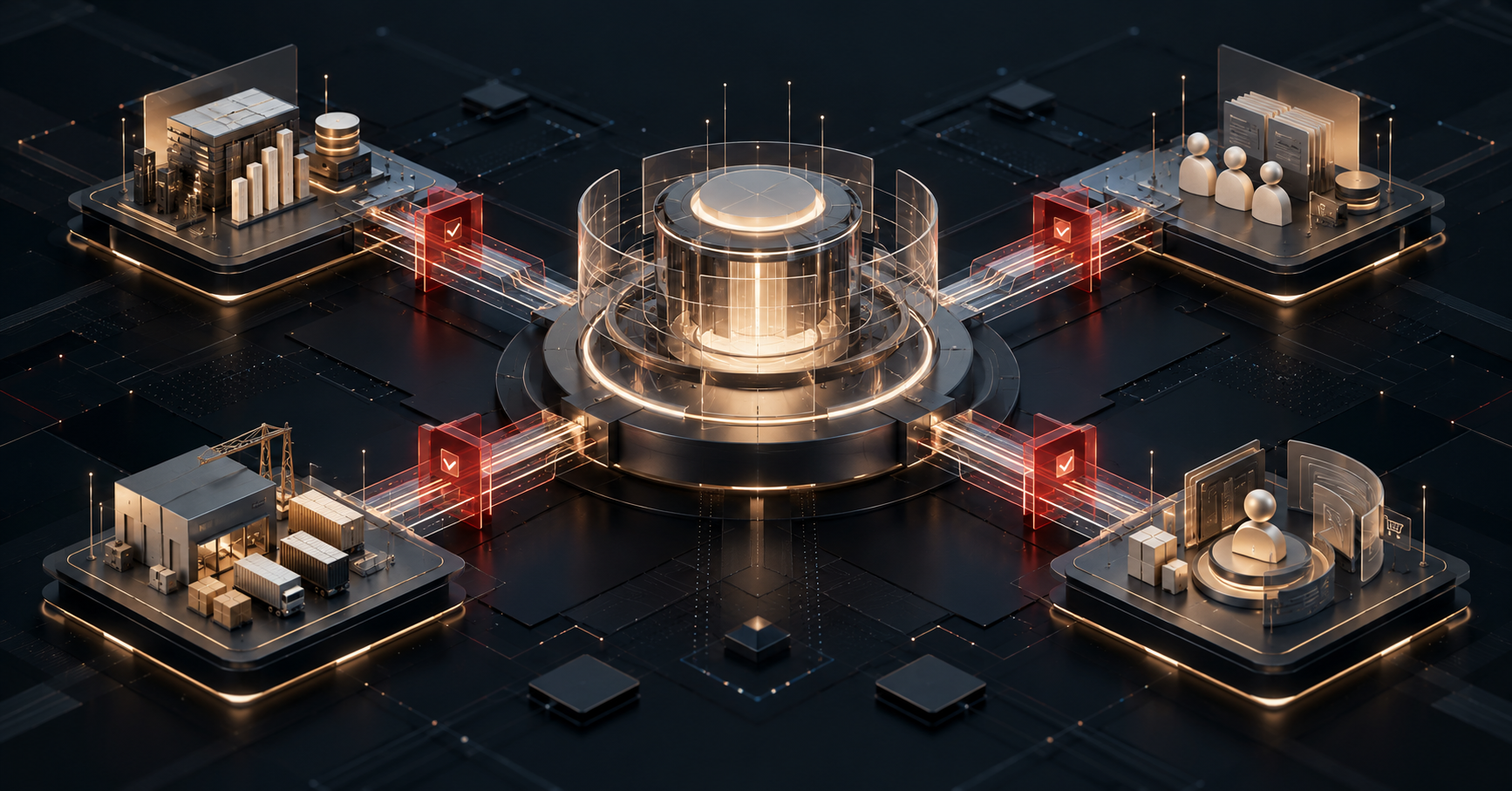
Oracle Fusion Claw is a governed execution runtime inside Fusion Applications. It combines model reasoning with deterministic computation, coordinates transactions and approvals, and can re-plan long workflows when conditions change. Oracle ships 25 Claw-powered applications in release 26D. The important idea is not autonomous ERP. It is an AI coordinator operating inside the permissions and controls the ERP already owns.
Oracle calls its new Fusion applications "outcome-driven AI." That sounds like the usual promise: tell the system what you want, disappear for lunch, and return to a finished business outcome.
The actual architecture is more restrained and more interesting.
Fusion Claw does not replace the ERP, its workflows, or the people accountable for them. It sits above those pieces and coordinates them. A person defines the objective. Claw can reason about the work, run deterministic calculations, invoke transactions, monitor progress, adapt the plan, and send consequential actions through existing approvals.
In other words, Oracle is not removing the rails. It is teaching the train how to choose a route while keeping it on them.
What is Oracle Fusion Claw?
Fusion Claw is the execution runtime behind a new class of Oracle Fusion Agentic Applications. Oracle says release 26D includes 25 Claw-powered applications across finance, human resources, supply chain, and customer experience.
The runtime is designed for work that is too large for a single prompt or a simple question-answer agent. Oracle describes five relevant capabilities:
- model reasoning for interpreting objectives and choosing next steps;
- deterministic computation for calculations that should not depend on a probabilistic answer;
- long-running execution across many steps and large data sets;
- continuous re-planning when the underlying business state changes;
- governed action through Fusion permissions, policies, transactions, and approvals.
That combination matters. A language model may decide which accounting exception needs investigation. It should not improvise the arithmetic that closes the ledger. A model may draft a workforce plan. It should not silently hire, terminate, or move people outside organizational approval.
Claw's architectural bet is that enterprise agents need both kinds of work in one controlled runtime.
How is this different from an ordinary AI assistant?
An assistant answers. An execution runtime maintains responsibility for a process.
Suppose a finance leader asks, "Get us ready for month-end close." A conversational assistant can summarize the checklist or draft an email. A Claw-powered application is intended to work across the underlying entries, identify exceptions, run deterministic analyses, recommend corrections, route approvals, and keep watching until the defined outcome is reached.
Oracle's examples include a Ledger application that investigates accounting exceptions, a Workforce Orchestration application that evaluates hiring and redeployment options, and a Payroll Activity Workspace that compares current and prior periods and prepares follow-up actions for review.
The difference is not that one uses AI and the other does not. It is state, scope, and authority. The agentic application knows the business object it is responsible for, the systems it may touch, the rules it must obey, and what completion means.
What does the architecture get right?
It puts the agent where the permissions already live
Consumer agents often begin by asking for a username and password, then impersonate the user in a browser. That is why banks have started blocking third-party AI agents: an unidentified bot with full credentials looks like an account takeover.
Fusion takes the opposite route. The agent operates inside a system that already has roles, business objects, approval chains, and audit expectations. That does not make every action safe, but it gives the design a real control plane instead of asking the model to behave.
It separates judgment from calculation
Models are useful when the input is ambiguous and the next step requires interpretation. They are the wrong place for accounting arithmetic, policy enforcement, and other operations with one correct result.
Oracle explicitly pairs AI reasoning with deterministic computation. That is the same design principle we use in production agent systems: let the model handle bounded judgment, then verify or execute consequential operations in code.
It acknowledges that enterprise work is long-running
A real process rarely completes in one model turn. It may wait for a person, a shipment, a nightly batch, or a new data point. Claw is described as supporting continuous re-planning across changing conditions instead of treating every run as a fresh chat.
This is the same runtime problem AWS is exploring with Infinity: how to suspend an agent while it waits and resume it when an event arrives. We cover the release and its limits in this week's Signal / Noise analysis. Oracle approaches the problem from inside the application suite; AWS approaches it as infrastructure. Both recognize that waiting and state are first-class parts of an agent, not edge cases.
What remains unproven?
The architecture is plausible. The outcomes are still vendor claims.
Oracle says the 25 applications are available in release 26D, but availability does not answer the questions a buyer should ask:
| Question | Why it matters |
|---|---|
| Workflow completion rate | How often does the agent finish without human repair? A successful demo is not a production success rate. |
| Approval and escalation frequency | Too many checkpoints erase the promised efficiency. Too few increase risk. |
| Cost per completed outcome | Token cost is only one part of runtime, integration, review, and exception handling. |
| Re-planning after data changes | Continuous re-planning can correct a workflow or make it unstable. |
| Trace, eval, and contract portability | Portability determines how expensive the next platform decision becomes. |
Oracle also uses the word autonomous in its marketing. The published mechanics describe governed autonomy: actions remain subject to permissions, policies, and organizational review. That is a feature, not a weakness. Buyers should evaluate the controls, not reward the biggest autonomy claim.
How does Claw relate to Oracle's other AI products?
The names are easy to blur, so keep the layers separate:
- Fusion Claw is the execution runtime for complex, long-running work.
- Fusion Agentic Applications are the packaged outcome-oriented applications powered by Claw.
- Fusion Companion is the interaction layer that interprets a person's objective and coordinates the relevant workflows and agents.
- Fusion Agentic Home is the user experience for delegating work and tracking progress.
- Oracle AI Agent Studio for Fusion Applications is the environment for customers and partners to create, extend, and manage agents.
Calling all five "Oracle's AI agent" loses the architecture. One is the engine, some are packaged vehicles, one is the dashboard, and one is the workshop.
Who should evaluate it?
Fusion Claw is most relevant if three things are already true:
- Oracle Fusion owns a meaningful share of your operational data and transactions.
- The workflow crosses several steps, teams, or Fusion modules.
- The outcome is valuable enough to justify formal permissions, approvals, evaluation, and monitoring.
It is less compelling for a narrow task that a deterministic workflow or single model call already handles. Adding an agentic runtime to a simple automation creates more state, more evaluation work, and more ways to fail.
The best first use case is not the process with the most impressive demo. It is a bounded process with expensive coordination, clear completion criteria, good historical data, and a human owner who can define the exceptions.
The builder's verdict
Fusion Claw is interesting because it makes a less glamorous promise than autonomous enterprise software.
It says the agent can understand a goal, coordinate existing systems, calculate some things deterministically, adapt when conditions change, and remain inside the controls the business already trusts. That is close to how production agents should be built.
The open question is not whether Oracle can put a model inside Fusion. It is whether each packaged application can demonstrate reliable completion, manageable exception rates, useful traces, and a cost per outcome that beats the workflow it replaces.
That is the evaluation we would run before expanding from one bounded process to 25.
If you are evaluating an agentic workflow inside Oracle or another enterprise stack, show us the process. We will help separate the steps that need AI judgment from the ones that need deterministic code, permissions, and a human decision.